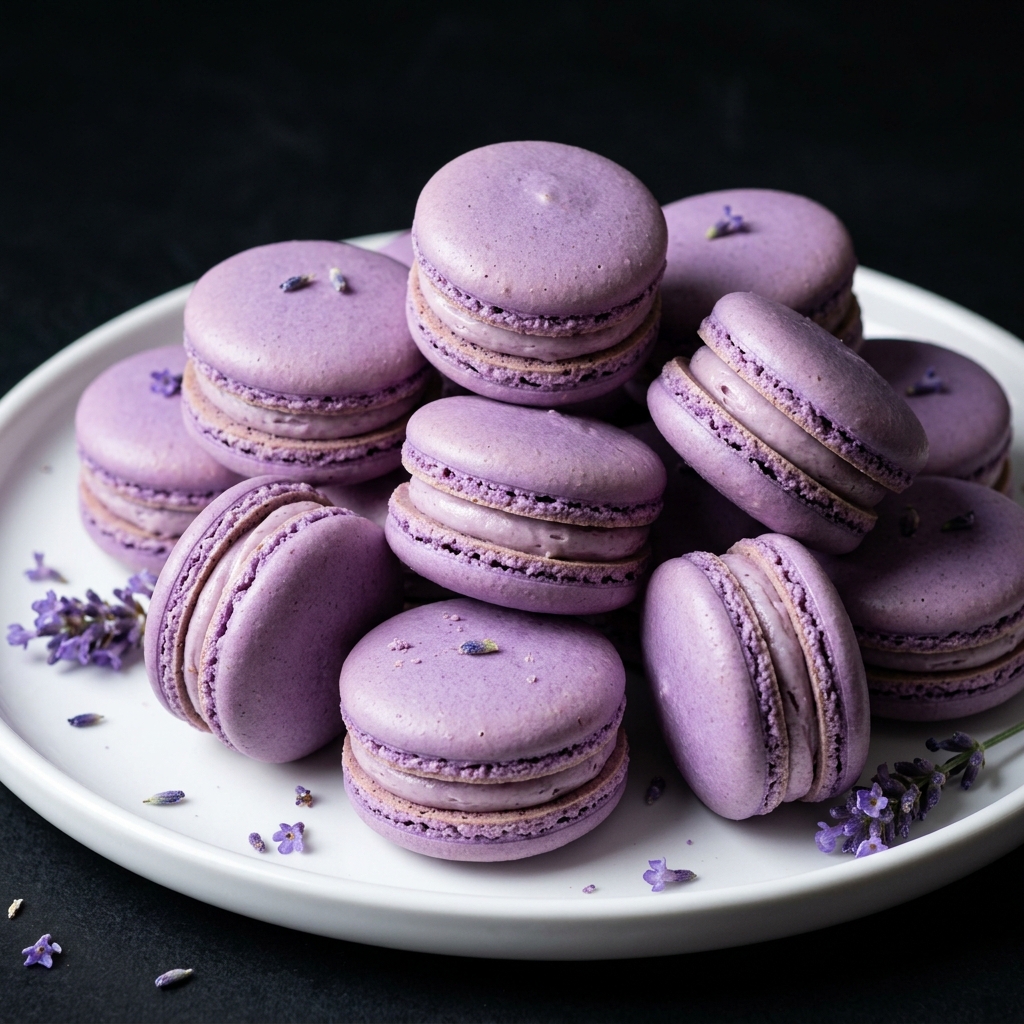
Delicate, colorful, and irresistibly elegant, these Lavender Macarons bring together crisp, airy French macaron shells, a silky lavender-infused filling, and just the right touch of floral flavor. They may look like something reserved for an upscale pastry shop, but with the right technique and a little patience, you can create these beautiful homemade macarons in your own kitchen.
Ingredients for Lavender Macarons

For the Macaron Shells
Almond flour – 100 g
Use finely ground almond flour rather than coarse almond meal. Fine almond flour helps create smoother macaron shells with a more refined texture. If your almond flour looks particularly coarse, sift it thoroughly before using it.
Powdered sugar – 100 g
Powdered sugar provides sweetness and contributes to the smooth structure of the shells. Sift it together with the almond flour to eliminate lumps.
Granulated sugar – 100 g
Granulated sugar stabilizes the whipped egg whites and gives the meringue the structure it needs. Fine granulated or caster sugar works especially well because it dissolves more easily.
Egg whites – 100 g
Use egg whites without any trace of yolk, as even a small amount of fat can interfere with proper whipping. Room-temperature egg whites generally whip more easily and produce a stable meringue.
Dried culinary lavender – 1 teaspoon
Use culinary-grade lavender intended for cooking. Lavender can be quite potent, so a modest amount is enough to provide a gentle floral character without overpowering the macarons.
Lavender gel food coloring – a small amount
A concentrated gel coloring gives the shells their beautiful lavender hue without adding too much liquid to the macaron batter. Start with a small amount and add more only if necessary.
Vanilla extract – 1 teaspoon
Vanilla rounds out the floral flavor and prevents the lavender from becoming too sharp or one-dimensional.
For the Lavender Buttercream Filling
Unsalted butter – 115 g
Use softened unsalted butter for a smooth and creamy buttercream. Allow it to soften naturally rather than melting it.
Powdered sugar – 180 g
Powdered sugar provides sweetness and structure. Sift it before adding it to the butter to create a smoother filling.
Heavy cream or milk – 1 to 2 tablespoons
A small amount of cream or milk helps loosen the buttercream and gives it a silky, pipeable consistency.
Culinary lavender – ½ teaspoon
A small amount of culinary lavender adds floral depth to the filling. For a particularly delicate flavor, you can infuse the cream with lavender and strain it before using.
Vanilla extract – ½ teaspoon
Vanilla balances the floral notes and gives the buttercream a fuller flavor.
Lavender gel food coloring – optional
A tiny amount can be used if you want the filling to have a stronger lavender appearance.

How to Make Lavender Macarons
French macarons are not difficult because they require unusual ingredients. They are challenging because several small details must come together at exactly the right time. Work carefully, avoid rushing, and pay close attention to the texture of the batter.
Step 1: Prepare the Baking Equipment
Before making the batter, prepare everything you will need. Line two baking sheets with parchment paper or silicone macaron mats.
Fit a piping bag with a round piping tip. Having the equipment ready before making the meringue is important because the macaron batter should be piped soon after it reaches the correct consistency.
Make sure your mixing bowl and whisk attachments are completely clean and dry. Any grease or moisture can prevent the egg whites from whipping properly.
Step 2: Sift the Dry Ingredients
Add the almond flour and powdered sugar to a large bowl.
Sift them together at least once, preferably twice. This step may seem unnecessary, but it makes a noticeable difference in the finished macarons. Large pieces of almond flour can prevent the shells from becoming smooth and can contribute to an uneven surface.
If there are larger almond particles left in the sieve, discard them rather than forcing them through.
Add the dried culinary lavender to the sifted mixture and gently combine.
Step 3: Make the French Meringue
Place the egg whites in a completely clean mixing bowl.
Begin whipping them at medium speed until they become foamy. Gradually add the granulated sugar rather than adding it all at once.
Continue whipping until the mixture becomes thick, glossy, and forms stiff peaks.
The meringue should hold its shape when the whisk is lifted. However, avoid whipping it far beyond the stiff-peak stage because an overly dry or unstable meringue can make the macaron batter difficult to incorporate.
Add the vanilla extract and a small amount of lavender gel coloring toward the end of whipping.
The color should be slightly stronger than you want the finished shells to appear because the dry ingredients will lighten it somewhat.
Step 4: Combine the Meringue and Dry Ingredients
Add approximately one-third of the sifted almond flour and powdered sugar mixture to the meringue.
Using a silicone spatula, gently fold it into the egg whites.
Add another portion and continue folding. Finally, add the remaining dry ingredients.
At this stage, the goal is not simply to combine everything. You need to develop the correct batter consistency through a process called macaronage.
Step 5: Master the Macaronage
Macaronage is one of the most important stages of the entire recipe.
Fold the batter gently at first, then gradually become more deliberate as the mixture loosens. Press the batter against the side of the bowl occasionally to release some of the air.
Continue folding until the batter flows slowly from the spatula and falls back into the bowl in a smooth ribbon.
A useful visual test is to lift the spatula and allow some batter to fall back into the bowl. The ribbon should blend back into the remaining batter rather than sitting prominently on top.
You want a batter that is fluid but not runny.
If the batter is too thick, the piped macarons may retain peaks and develop rough tops. If it is too thin, the shells may spread excessively and fail to develop their characteristic structure.
This is why macaronage should be done gradually rather than following an exact number of folds.
Step 6: Pipe the Macaron Shells
Transfer the batter to the prepared piping bag.
Hold the piping bag vertically over the baking sheet and pipe evenly sized rounds, leaving space between each one.
Try to keep the pressure consistent so the macarons are approximately the same size. Consistent shells are important because matching two shells later is much easier when they have been piped evenly.
Once all the rounds are piped, gently tap the baking sheet against the counter several times.
This helps release large trapped air bubbles. If you notice visible bubbles on the surface, pop them carefully with a clean toothpick.
Step 7: Allow the Shells to Rest
Leave the piped macarons at room temperature until a dry skin forms on the surface.
The exact time varies depending on the humidity in your kitchen. It can take roughly 20 to 60 minutes, sometimes longer in humid conditions.
To test them, lightly touch the surface of one shell with a clean fingertip. The batter should no longer stick to your finger.
This resting stage is important because the dry outer skin helps the macarons rise upward in the oven instead of spreading outward. It also encourages the formation of the characteristic ruffled “feet” around the bottom of the shells.
Step 8: Bake the Macaron Shells
Preheat your oven according to your oven’s characteristics, generally around 150°C / 300°F.
Bake the macarons until the shells have developed firm tops and recognizable feet.
Depending on the size of your macarons and the behavior of your oven, baking generally takes around 12 to 16 minutes.
Avoid opening the oven repeatedly during the early part of baking because sudden temperature changes can cause delicate shells to collapse.
The finished shells should feel set on top while remaining slightly chewy inside.
Because every oven behaves differently, your first batch may require a small adjustment to the temperature or baking time. Once you understand how your oven behaves, subsequent batches become much easier.
Step 9: Cool the Shells Completely
Remove the baking sheet from the oven and allow the shells to cool completely before attempting to remove them from the parchment or silicone mat.
Warm macarons are fragile and can easily break.
Once completely cool, gently lift the shells and arrange them in pairs according to size.
Matching shells before filling makes the finished macarons look much more polished and professional.
Making the Lavender Buttercream
While the shells cool, prepare the filling.
Beat the softened butter until smooth and creamy. Gradually add the sifted powdered sugar and continue mixing until the buttercream becomes light and fluffy.
Add the vanilla extract and culinary lavender.
Slowly add the heavy cream or milk, a little at a time, until the buttercream reaches a smooth, creamy, pipeable consistency.
If desired, add a tiny amount of lavender gel food coloring to create a soft purple filling.
For an especially refined lavender flavor, the cream can be gently infused with culinary lavender before being cooled and strained. This creates a more evenly distributed floral flavor and eliminates larger lavender pieces from the buttercream.
The finished filling should be smooth enough to pipe but firm enough to hold its shape.
Filling and Assembling the Macarons
Transfer the lavender buttercream to a clean piping bag fitted with a round tip.
Pipe a small mound of buttercream onto the flat side of one macaron shell.
Place a matching shell on top and gently press until the filling reaches near the edges without spilling out.
Repeat with the remaining shells.
Do not squeeze the macarons too aggressively. A gentle pressure is enough to distribute the filling evenly.
Once assembled, place the macarons in an airtight container and refrigerate them for at least 12 to 24 hours if possible.
Although they are tempting to eat immediately, resting allows the filling to soften the interior of the shells slightly. This creates the classic macaron texture: delicate on the outside, chewy in the center, and creamy throughout.
Bring them to room temperature before serving for the best flavor and texture.

The Most Important Thing to Remember
If your first batch of lavender macarons does not look perfect, do not assume the recipe has failed. Macarons are unusually sensitive to humidity, oven temperature, ingredient measurement, meringue strength, and batter consistency.
The most important skill to develop is learning what properly mixed macaron batter looks and feels like. Once you can recognize the correct macaronage consistency, the entire process becomes considerably more predictable.
And when those beautiful purple shells emerge from the oven with smooth tops and delicate feet, you will understand why homemade lavender macarons are worth every careful step.
Lavender Macaron Variations
One of the best things about homemade macarons is how easily the basic recipe can be adapted. Once you are comfortable with the classic lavender version, you can experiment with different fillings, flavor combinations, and decorative touches while keeping the elegant lavender theme.
Lemon Lavender Macarons
For a brighter, more refreshing macaron, combine lavender with lemon. Add a small amount of finely grated lemon zest to the buttercream and replace a portion of the cream with fresh lemon juice.
The citrus cuts through the sweetness of the buttercream while complementing lavender’s floral character. These are particularly delicious for spring and summer gatherings.
Honey Lavender Macarons
Honey and lavender are a natural pairing. Add a small amount of honey to the buttercream, reducing the liquid slightly if necessary to maintain a pipeable consistency.
The honey gives the filling a warm, rounded sweetness that works beautifully with the delicate floral notes.
White Chocolate Lavender Macarons
For a richer and more luxurious variation, prepare a white chocolate ganache infused with culinary lavender instead of buttercream.
White chocolate provides a creamy sweetness that balances lavender extremely well. Allow the ganache to cool and thicken before piping it between the macaron shells.
Vanilla Lavender Macarons
If you prefer a subtle floral flavor, increase the vanilla slightly while keeping the lavender modest.
This version is ideal for people who enjoy the appearance and aroma of lavender but do not want an intensely floral dessert.
Berry Lavender Macarons
Lavender pairs beautifully with berries such as raspberries, blueberries, and blackberries.
Try adding a thin layer of raspberry or blueberry preserve inside the buttercream before sandwiching the shells. The tart fruit provides contrast against the sweet filling and creates a more complex dessert.
Expert Tips for Perfect Lavender Macarons
Measure Everything by Weight
A kitchen scale is one of the most useful tools you can own for making macarons.
Measuring ingredients by volume can produce inconsistent results because ingredients such as almond flour and powdered sugar can vary significantly in density. Small differences matter when working with such a precise recipe.
For the most reliable results, weigh your ingredients in grams.
Use Room-Temperature Egg Whites
Room-temperature egg whites tend to whip more readily and can produce a stable meringue.
If you separate your eggs in advance, keep the egg whites covered and refrigerated until needed, then allow them to come to room temperature before beginning.
Keep Fat Away From the Meringue
The mixing bowl and beaters must be completely clean and dry.
Egg whites cannot whip properly when contaminated with grease. Even traces of egg yolk can interfere with the formation of a strong meringue.
If you are unsure whether your bowl is completely grease-free, wipe it with a little lemon juice or vinegar and dry it thoroughly before beginning.
Do Not Overdo the Lavender
Lavender is powerful.
Using too much can make the macarons taste bitter, medicinal, or overly perfumed. The goal is a subtle floral character that makes people wonder what makes the dessert taste so elegant rather than immediately overwhelming them with lavender.
Always use culinary-grade lavender and start conservatively.
Sift the Almond Flour and Powdered Sugar
Smooth macaron shells begin with a smooth dry mixture.
Sifting removes larger particles and helps prevent lumps from appearing on the surface of the shells. For especially polished macarons, sift the dry ingredients twice.
Watch the Batter Rather Than the Clock
When making macaron batter, the number of folds is less important than the final consistency.
Your batter should flow smoothly from the spatula and gradually blend back into the rest of the mixture. If it remains stiff and forms peaks, it probably needs additional folding.
If it becomes extremely runny, it may have been overmixed.
Learning to recognize the correct consistency is one of the biggest steps toward becoming confident with macarons.
Let the Shells Form a Skin
Never rush straight from piping to baking.
The surface should become dry enough that a light touch does not leave batter on your fingertip. This skin helps the shells rise upward during baking and contributes to the formation of the characteristic macaron feet.
Humidity can dramatically affect this stage, so allow extra time when necessary.
Use an Oven Thermometer
Many home ovens are not perfectly accurate.
An oven might display 150°C while actually running considerably hotter or cooler. Because macarons are sensitive to temperature, an inexpensive oven thermometer can help you understand what is really happening inside the oven.
If your macarons repeatedly brown, crack, remain wet inside, or spread excessively, oven temperature may be part of the problem.
Bake a Test Batch
If you are making macarons for an important event, avoid committing the entire batch to the oven at once.
Bake a few shells first and observe their behavior. If they spread, brown too quickly, crack, or fail to develop feet, you can make an adjustment before baking the rest.
This simple step can save an entire batch.
What to Serve With Lavender Macarons
Lavender macarons are elegant enough to stand on their own, but they become even more enjoyable when paired with complementary drinks and desserts.
Tea
Tea is one of the most natural companions for macarons.
Serve them with Earl Grey, English Breakfast, chamomile, green tea, or a mild black tea. Earl Grey is particularly appealing because its citrusy bergamot notes complement lavender beautifully.
Coffee
A small cup of espresso or a smooth latte balances the sweetness of the macarons.
For an especially indulgent dessert experience, serve two or three lavender macarons alongside a cappuccino.
Lemon Desserts
Because lemon and lavender complement each other so well, a lemon tart, lemon cake, or lemon curd can create a beautiful dessert pairing.
The acidity of lemon helps balance the sweetness of the macarons.
Fresh Berries
Fresh raspberries, blueberries, and blackberries provide natural tartness and vibrant color.
Arrange a small selection of berries around the macarons when serving them on a dessert platter for an elegant presentation.
Afternoon Tea Dessert Boards
Lavender macarons work beautifully on an afternoon tea platter alongside small cakes, shortbread cookies, fresh fruit, scones, and delicate sandwiches.
Their purple color also makes them an attractive centerpiece on an otherwise neutral dessert table.
How to Store Lavender Macarons
Proper storage is important because macarons actually improve after they have had time to mature.
Place the finished macarons in an airtight container and refrigerate them. If possible, allow them to rest for 12 to 24 hours before serving.
Stored properly in the refrigerator, filled macarons can generally remain enjoyable for several days.
Before serving, remove them from the refrigerator and let them sit at room temperature for approximately 15 to 30 minutes. This allows the buttercream to soften and the flavors to become more noticeable.
Unfilled macaron shells can also be stored separately in an airtight container. This can be particularly useful when preparing them ahead of an event.
For longer storage, assembled macarons can be frozen in a well-sealed container. Place parchment between layers if necessary to prevent them from sticking together. Thaw them gradually in the refrigerator before bringing them to room temperature.
Avoid leaving macarons uncovered because their delicate shells can absorb moisture and odors from the surrounding environment.
Why Did My Lavender Macarons Crack?
Cracked macaron shells can happen for several reasons.
The meringue may have been unstable, the batter may have been improperly mixed, the shells may not have rested long enough, or the oven temperature may have been too high.
Excessive air trapped in the batter can also contribute to cracking. After piping, carefully popping visible air bubbles with a toothpick can help.
If cracking happens repeatedly, try adjusting one variable at a time rather than changing everything simultaneously. This makes it easier to identify the underlying problem.
Why Don’t My Macarons Have Feet?
The ruffled edge around the bottom of a macaron is known as the foot.
If your macarons lack feet, possible causes include an improperly whipped meringue, overmixed batter, insufficient resting time, or an oven temperature that is not appropriate for your particular oven.
Humidity can also make it difficult for the shells to develop a proper skin before baking.
Do not immediately assume that one specific problem is responsible. Macarons are sensitive to several variables, so troubleshooting works best when you evaluate the entire process.
Why Are My Macarons Hollow?
Hollow shells can be frustrating, especially when the exterior looks beautiful.
Possible causes include an overly strong oven temperature, an unstable meringue, insufficient macaronage, or improper cooling.
The shell may rise rapidly in the oven while leaving an empty space underneath the top crust.
Allowing the macarons to cool completely before handling them is important. With practice, adjusting your whipping, folding, and baking technique can help produce a more balanced interior.
Why Are My Macarons Too Sweet?
Macarons naturally contain a significant amount of sugar, so sweetness is part of their character.
However, the sweetness can be balanced through the filling and flavor combinations.
Lavender, lemon, berries, espresso, and other slightly bitter or acidic flavors can provide contrast. Using a less-sweet filling can also prevent the finished dessert from becoming overwhelming.
Avoid dramatically reducing the sugar in the macaron shells, however, because sugar contributes to their structure as well as their sweetness.
Frequently Asked Questions
Can I use fresh lavender instead of dried lavender?
Fresh lavender can be used in some applications, but dried culinary lavender is generally easier to measure and incorporate into macarons. Most importantly, make sure the lavender is food-grade and specifically intended for culinary use.
Can I make lavender macarons without food coloring?
Yes. Food coloring is completely optional.
Without coloring, the macarons will have a naturally pale cream or slightly beige appearance. If you want the recognizable lavender-purple color, use a small amount of gel food coloring rather than liquid coloring.
Can I make these macarons ahead of time?
Yes. Macarons are actually excellent make-ahead desserts.
The shells can be prepared in advance, and filled macarons can be refrigerated until needed. Their texture often becomes even better after resting because the filling has time to soften the interior of the shells.
How strong should the lavender flavor be?
Lavender should generally remain subtle.
A successful lavender macaron should taste primarily like a delicate, sweet almond macaron with a recognizable floral note rather than tasting intensely like lavender soap or perfume.
If you are new to baking with lavender, start with a smaller amount and increase it in future batches if you prefer a stronger flavor.
Why are my macarons sticking to the parchment?
If the shells stick badly after cooling, they may be slightly underbaked.
Allow them to cool completely before removing them. If they continue to stick, the next batch may need a little more baking time.
Different parchment papers and silicone mats can also behave differently, so using quality baking surfaces can make a noticeable difference.
Can I make these macarons without almond flour?
Traditional French macarons are made with finely ground almonds, which provide much of their characteristic texture.
Alternative nut or seed-based versions are possible, but changing the flour substantially can alter the structure and require recipe adjustments. For classic lavender macarons, finely ground almond flour is the most reliable choice.
Are lavender macarons gluten-free?
Traditional macarons made with almond flour, powdered sugar, egg whites, and gluten-free flavoring ingredients are naturally gluten-free.
However, if you are preparing them for someone with celiac disease or a serious gluten sensitivity, check every packaged ingredient for potential cross-contact and verify that your food coloring, flavorings, and other additions are suitable.
Can I make these macarons vegan?
A traditional French macaron recipe contains egg whites, so it is not vegan.
Vegan macarons can be made using aquafaba as an egg-white alternative, but the technique and ingredient ratios are different. They should be treated as a separate recipe rather than simply replacing egg whites in a traditional formula.

Lavender Macarons
Ingredients
Equipment
Method
- Prepare the baking sheets: Line two baking sheets with parchment paper or silicone macaron mats. Fit a piping bag with a round piping tip.
- Sift the dry ingredients: Sift the almond flour and powdered sugar together, preferably twice. Stir in the dried culinary lavender.
- Whip the egg whites: Place the egg whites in a clean, grease-free mixing bowl. Whip until foamy, then gradually add the granulated sugar. Continue beating until a glossy, stable meringue with stiff peaks forms.
- Add flavor and color: Mix in the vanilla extract and a small amount of lavender gel food coloring.
- Make the macaron batter: Add the dry ingredients to the meringue in portions, gently folding after each addition. Continue folding until the batter becomes smooth and flows slowly from the spatula in a continuous ribbon.
- Pipe the shells: Transfer the batter to the piping bag. Pipe evenly sized rounds onto the prepared baking sheets, leaving space between each one.
- Remove air bubbles: Gently tap each baking sheet against the counter several times. Use a toothpick to pop any visible air bubbles.
- Rest the shells: Leave the piped macarons at room temperature until the surface becomes dry to the touch, usually about 20–60 minutes depending on humidity.
- Bake: Preheat the oven to approximately 150°C (300°F). Bake for 12–16 minutes, adjusting the time according to your oven and macaron size.
- Cool: Allow the shells to cool completely on the baking sheets before carefully removing them.
- Prepare the buttercream: Beat the softened butter until creamy. Gradually add the powdered sugar, followed by the vanilla extract and culinary lavender. Add the cream or milk gradually until the buttercream becomes smooth and pipeable. Add lavender gel coloring if desired.
- Fill the macarons: Transfer the buttercream to a piping bag. Pipe a small mound onto the flat side of one shell, then gently sandwich it with a matching shell.
- Mature the macarons: Place the filled macarons in an airtight container and refrigerate for 12–24 hours. Bring them to room temperature for about 15–30 minutes before serving for the best texture and flavor.
Notes
Lavender has a strong flavor, so avoid using too much. The finished macarons should have a delicate floral taste rather than an overpowering perfume-like flavor.
Weigh ingredients with a kitchen scale for the most consistent results.
Make sure the mixing bowl and beaters are completely free of grease before whipping the egg whites.
The macaron batter should flow slowly and smoothly from the spatula. Overmixing can make the batter too thin, while undermixing can leave the shells peaked and uneven.
Resting time varies with humidity. The shells are ready for baking when they feel dry to the touch.
For the best texture, allow the assembled macarons to mature in the refrigerator for 12–24 hours before serving.
Store filled macarons in an airtight container in the refrigerator for several days and allow them to come to room temperature before serving.
For variations, try pairing lavender with lemon, honey, white chocolate, raspberry, blueberry, or vanilla.

Hi, I’m Clara, the creator of Barakala. I love sharing simple, comforting, and delicious recipes that make everyday cooking easier and more enjoyable for home cooks.